Notes A–Z
Vanilla in Perfume: Cured Pods, Cream and Dry Balsamic Wood
Vanilla smells warm, softly sweet and balsamic, with possible creamy, woody, smoky or dried-fruit facets. It can suggest a cured pod rather than frosting.
4 min readNotes A–Z
Amber in perfume usually smells warm, resinous and softly sweet, with vanilla, balsamic and sometimes leathery facets.
By The Bla Blu Bli Fragrance Library editors · Published October 21, 2026 · Updated October 22, 2026 · 4 min read
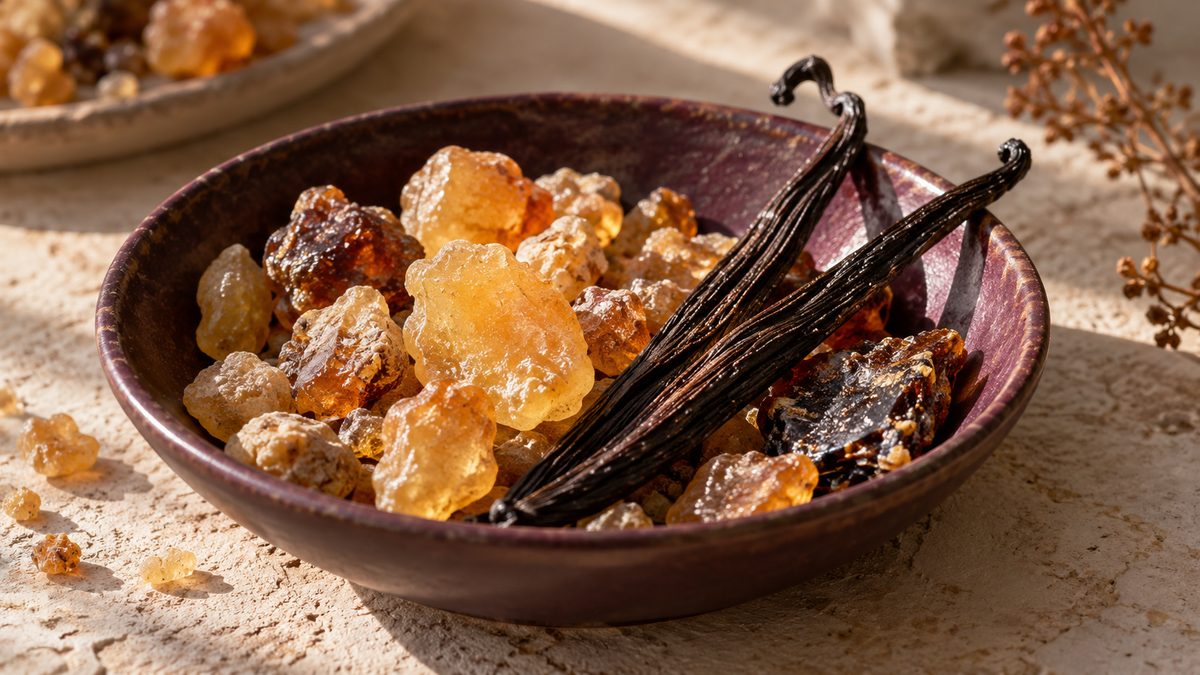
Amber in perfume usually smells warm, resinous and softly sweet, with vanilla, balsamic and sometimes leathery facets. It is normally an accord built from several materials, rather than an extract of the fossilised resin used in jewellery. The useful question is which kind of warmth a particular amber gives you: soft and powdery, dark and sticky, or dry and woody.
A traditional amber effect often centres on labdanum, benzoin and vanilla-like materials. Labdanum is a resinous material obtained from rockrose shrubs, especially around the Mediterranean. It can suggest warm leather, dried vegetation and a slightly animalic depth. Benzoin comes from the resin of Styrax trees, including sources in Southeast Asia, and brings a sweeter balsamic character.
Vanilla supplies a familiar connection between these darker materials and a rounded, comforting smell. Vanillin can provide that effect without a whole vanilla extract. There is no compulsory recipe: a perfumer might make the accord very dry, expand it with woods, or leave the resins almost hidden beneath powder and sweetness.
These ingredients do not melt together into a new botanical substance. Accord means that their combined smell becomes recognisable as one idea. Think of amber as a recipe category whose proportions matter, rather than a plant name that identifies a single source.
Amber, ambergris and woody amber can lead to quite different samples. The distinction matters when you enjoy a soft resinous fragrance but dislike a sharp, persistent woody base.
| Term on a description | Useful scent expectation | What it cannot establish |
|---|---|---|
| Amber accord | Balsamic resins, vanilla warmth, possible powder | A fixed ingredient recipe |
| Ambergris effect | Mineral, salty, warm skin associations | The presence of an animal-derived material |
| Woody amber | Dry wood, firmness, sometimes strong diffusion | A soft or sugary texture |
The ambroxan profile explains an ambergris-related direction in more detail. None of these descriptions tells you the exact formula. A fragrance can combine all three effects and still list only amber in its publicity.
Amber commonly supplies the base of a perfume because many of its supporting materials are persistent. They give flowers and spices something warm to settle into. Yet you may smell amber from the first spray: a note pyramid describes relative emphasis, not separate compartments that open on a timer.
In a rose perfume, the accord can make the petals feel richer and darker. Under citrus it creates a bright-to-warm contrast. Beside spices it can suggest a heated resin or a dry, fragrant cupboard. The fragrance may become sweeter as its fresh opening recedes, even if the amount of sweet material on your skin is declining along with everything else.
Listen for the transition into the base. If the middle becomes blurred and the final trace feels uniformly sugary, that sample may contain more sweetness than you want. A drier amber can preserve warmth while giving wood or resin a clearer outline.
Vanilla rounds amber and makes its sweet side easier to recognise. Tonka adds hay-like and almond associations, often increasing the powdery impression. These combinations can feel edible, but amber does not have to resemble dessert.
Incense can pull the accord towards aromatic resin and dryness. Patchouli adds earth and dark wood; leather emphasises labdanum's rougher edge. With either pairing, check the later wear rather than assuming a dark opening will remain unsweetened.
Lavender and bergamot provide contrast above the base. Rose creates a floral centre that can stop the composition feeling like a solid block of resin. Choose the pairing according to the part you want to notice: flower, spice, wood or a continuous warm background.
Use two finished fragrance samples described differently, such as resinous amber and vanilla amber. Do not compare concentrated raw resins on skin. Their strength, handling and intended use are different from a wearable perfume.
Avoid turning the exercise into an ingredient-identification test. Without a formula, a leathery smell cannot prove that labdanum is present. Your goal is a repeatable description that helps select the next sample.
A dense amber often feels comfortable in cool air, especially when resin and spice remain distinct. In a warm room the same composition may seem fuller and sweeter. Start conservatively before a commute, meal or long meeting, where you cannot easily step away from the fragrance.
For daytime or warmer conditions, seek a clearer floral or citrus contrast and test the base before choosing. Pale liquid does not establish lightness, and dark liquid does not establish resin content. The smell and its reach provide better evidence than colour.
Natural resins can contain sensitising constituents, and a synthetic reconstruction is not automatically suitable for every wearer. Check the finished ingredient information and the allergen and patch-testing guidance. Stop using a fragrance that causes irritation; persistent or recurring symptoms belong with a clinician. Home trials cannot certify freedom from allergy.
A guide to the note’s usual role, not a fixed formula or an ingredient list.
Notes overlap as a fragrance develops. Placement varies with the finished composition.
Usually the familiar perfume effect is constructed from aromatic materials. Jewellery amber is not the normal source of a soft resin-and-vanilla accord, and stones in packaging do not explain the scent.
Yes, the accord can be built with plant-derived and manufactured ingredients. A note list does not establish the sourcing of the whole product, so request confirmation from the maker if that matters to you.
The expression usually describes an imagined style, often lighter, cleaner or muskier. It has no single botanical definition and should be treated as a sampling clue rather than an ingredient specification.
That depends on the finished product, fabric and application. Resinous or coloured fragrances can mark materials. Follow the product directions and avoid spraying delicate clothing merely because a perfume is called amber.
For general information. Patch test a finished perfume as directed before wider wear. Stop use and see a doctor if irritation develops.
Notes A–Z
Vanilla smells warm, softly sweet and balsamic, with possible creamy, woody, smoky or dried-fruit facets. It can suggest a cured pod rather than frosting.
4 min readNotes A–Z
Incense in perfume can smell resinous, aromatic and smoky, while frankincense itself often adds bright citrus-like, peppery and pine-like facets.
4 min readNotes A–Z
Ambroxan usually smells dry, woody and ambergris-like, with mineral, warm-skin or faintly salty associations.
4 min readNotes A–Z
What aldehydes mean in perfume, why some smell sparkling or soapy, and how these varied materials transform floral and clean fragrance accords.
4 min read