How to wear fragrance
How to Test Perfume in a Store or With Samples
Test perfume by limiting competing scents, assessing an opening on paper, and giving a suitable finished sample a separate skin-wearing day.
4 min readHow to wear fragrance
A practical counter routine for choosing men’s cologne: shortlist on paper, test on skin, wait for the drydown and check the exact version.
By The Bla Blu Bli Fragrance Library editors · Published November 2, 2026 · Updated November 2, 2026 · 4 min read
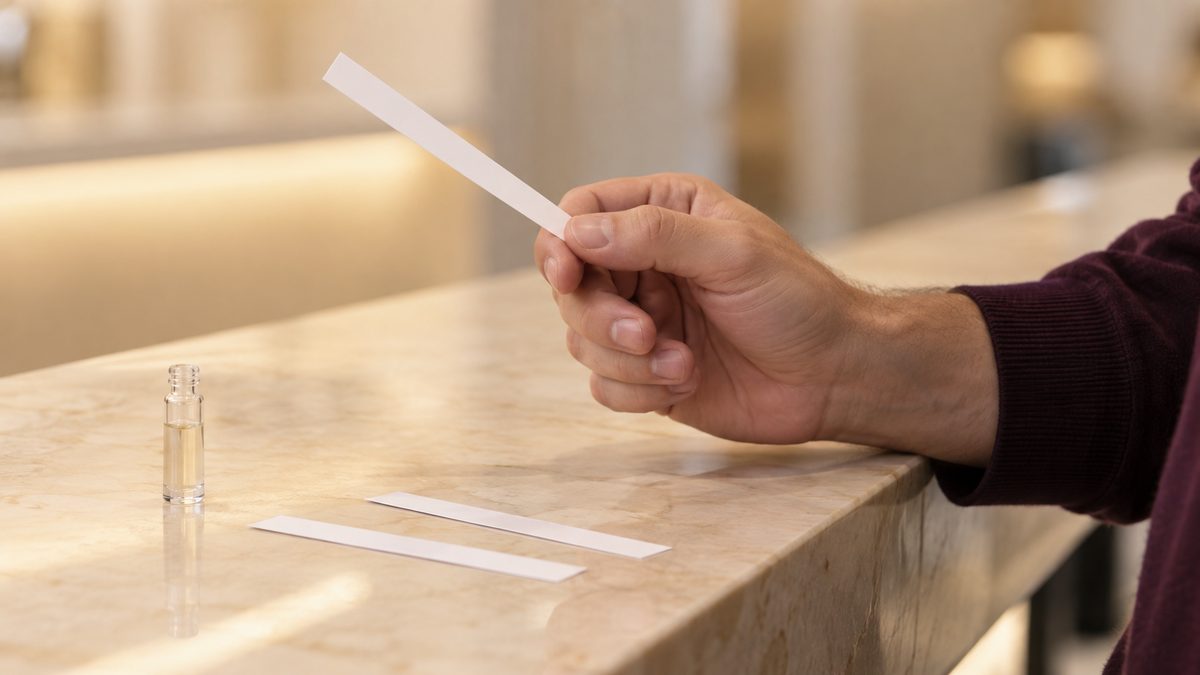
Choose men's cologne in a store by screening a small shortlist on paper, putting a clear favourite on skin, then leaving time for it to settle before buying. Start with two or three contrasting options rather than spraying every bottle. Treat that number as a manageable shopping plan, not a rule about what your nose can handle.
Once you have found a nearby counter, the main task is to create a comparison you can still understand an hour later. A good salesperson can help, but you need to give them a useful brief and keep the samples separate.
Describe where you expect to wear the scent and what you dislike. “For a shared office, with dry woods and little sweetness” gives more direction than “something masculine”. If you do not know note names, comparisons such as crisp, powdery, smoky or soft are enough to begin.
Mention any scent-free settings in your routine. No perfume becomes suitable for a fragrance-free workplace simply because it is sold as light. For other shared spaces, ask for a sample that you can assess at a modest application.
If you want a daily scent, say how often you plan to wear it. The signature scent guide can help frame that choice, but there is no need to arrive with a fixed fragrance identity.
Ask for two or three options that differ in a way you can describe. A fresher woody option and a softer, warmer woody option teach you more than several very similar suggestions.
Use a separate strip for each. Keep the product name and version associated with its strip, using a written note or asking the assistant to identify it. Let the wet spray settle before bringing it near your nose, and avoid touching the strip to your face.
Smell each briefly, with pauses between them. Put aside an immediate dislike rather than repeatedly checking it in the hope of changing your mind. If every strip begins to smell alike, stop for a break in cleaner air. More spraying is unlikely to clarify the comparison.
| Stage | What it helps you decide | What it cannot establish |
|---|---|---|
| First paper sniff | Whether the initial style appeals | How it will feel on your skin |
| Settled paper strip | Whether you enjoy the developing scent | Comfort through a normal wear day |
| Small skin application | How the exact sample develops on you | A universal performance result |
| Time outside the shop | How it feels away from other testers | Whether it suits every season |
| Another ordinary wear | Whether you want to keep wearing it | How another person will experience it |
Choose one favourite for skin if the decision is already clear. If two remain close, use separate areas, such as one on each forearm, and keep track of which is which. Do not spray them over each other.
Follow the product directions and use clean, intact skin. Leave the application alone rather than rubbing the areas together. If you have irritation or known fragrance allergy concerns, stop and seek appropriate professional advice instead of continuing the test.
There is no universal waiting time that reveals every perfume's full drydown. As a practical plan, check after about half an hour, then again later in the day. These are observation points rather than promises about when notes disappear.
Walk away from the fragrance department if possible. Notice the scent while doing something ordinary, without holding your wrist to your nose continuously. Does it distract you, feel too sweet, or make you want another brief smell?
The testing perfume guide gives a fuller method for a home sample. If you cannot stay long enough in store, ask whether a sample is available and record the exact item. Availability varies; a counter visit does not oblige you to buy that day.
Check whether you have tested the eau de toilette, eau de parfum or another version. Versions with similar names can differ in composition, so the bottle you buy should match the sample you enjoyed.
The concentration labels do not create a reliable strength ranking across all fragrances. Ask how this particular version is intended to wear, then use the sample to assess it for yourself.
Separate persistence from reach. A fragrance can remain detectable close to skin without filling a room. Our projection and sillage explanation helps distinguish those effects. For a shared setting, comfort at conversational distance is usually a more useful observation than how strongly you smell your wrist.
A cold-weather purchase may spend most of its time in heated rooms. A warm-weather purchase may need to move between outdoor heat and air conditioning. Ask how the sample feels in those conditions rather than choosing only from a summer or winter display.
Start with a modest application. Do not add more simply because cold air makes the scent seem quieter; assess it again indoors first. The seasonal perfume guide explains why temperature is part of the decision without being a strict rule for note families.
Before paying, confirm the exact name, version and concentration, then ask about sample options and the policy for opened fragrance. Keep a short note of what you liked after the opening settled. That gives you a clear reason to return for a bottle, and a clear stopping point if none of the samples suits you.
No special reset is necessary. Stop smelling for a while and move into cleaner air. If the scents start blending together, end the session and return another day.
Only if the product directions and fabric allow it. Fragrance can mark materials, and fabric wear does not fully predict skin wear. A paper strip is a better initial screening tool.
Perception can fade with continued exposure. Avoid adding more immediately; ask a willing person at normal conversational distance and assess again after a break.
You can wait. Record the exact product and assess the later scent first. A decision after an ordinary wear is more informed than one based on the first spray.
That depends on the seller’s current terms. Ask specifically about opened fragrance before buying and retain the relevant proof of purchase.
For general information. Patch test a finished perfume as directed before wider wear. Stop use and see a doctor if irritation develops.
How to wear fragrance
Test perfume by limiting competing scents, assessing an opening on paper, and giving a suitable finished sample a separate skin-wearing day.
4 min readConcentrations
Parfum, eau de parfum, eau de toilette and eau de cologne are concentration and style labels, while perfume oil describes a carrier format.
4 min readHow to wear fragrance
Projection describes how far a perfume seems to extend around the wearer, while sillage describes the trail it leaves as the wearer moves.
4 min readScent through the seasons
Summer fragrance choices often favor bright citrus, airy florals and dry woods, while winter choices may lean toward warm amber, vanilla and richer woody textures.
4 min read