How to wear fragrance
How to Test Perfume in a Store or With Samples
Test perfume by limiting competing scents, assessing an opening on paper, and giving a suitable finished sample a separate skin-wearing day.
4 min readHow to wear fragrance
Use perfume sampler sets over separate wear days, record useful comparisons and store small vials so you can revisit favourites.
By The Bla Blu Bli Fragrance Library editors · Published November 7, 2026 · Updated November 7, 2026 · 5 min read
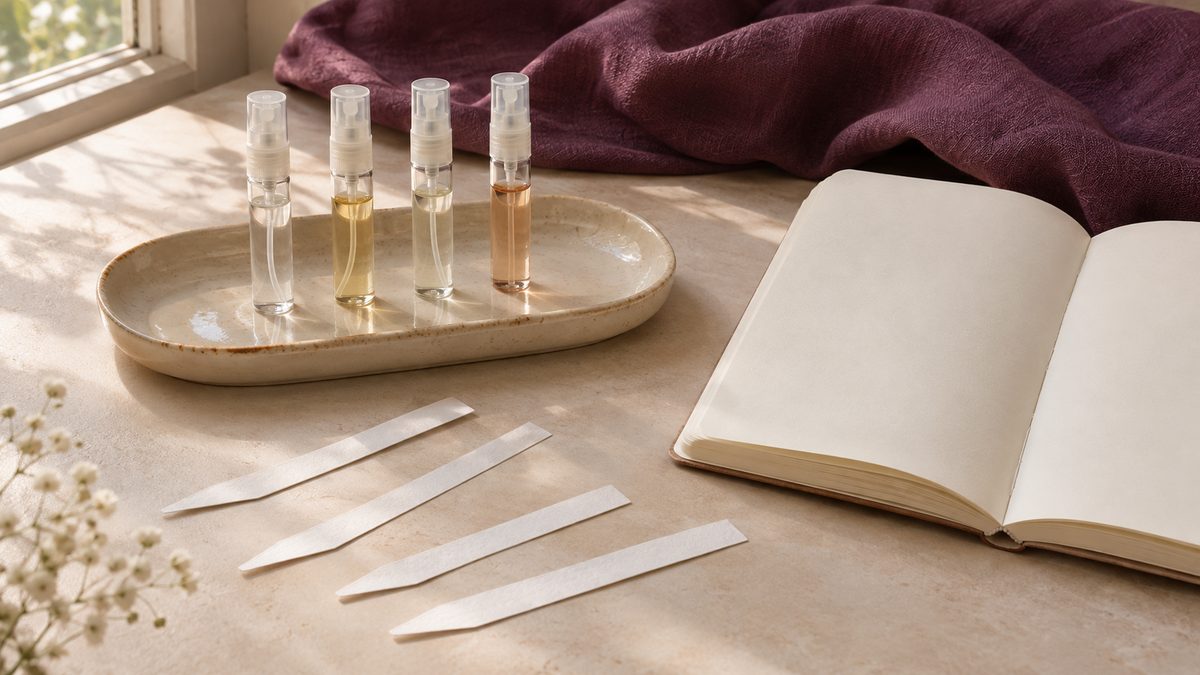
A perfume sampler set is a collection of small fragrances intended to help you explore or compare scents before committing to a bottle. The most useful way to test one is to screen the selection on paper, wear promising samples on separate days, and repeat your favourites under similar conditions.
A cologne sampler set serves the same purpose. The wording alone does not tell you the concentration, scent family or gender of the person who will enjoy it. Read the contents and decide what you want the set to help you learn.
A broad discovery set helps if you cannot yet describe your preferences. Contrasting a fresh citrus, a dry wood and a soft floral can reveal more than comparing several close variations. Someone who already knows they love woods may prefer a narrower selection that explores different textures within that family.
Before buying, check the individual volumes, applicators and exact fragrance versions. A set of dab vials is a different testing experience from a set of sprays. If there is a bottle redemption offer, read its current conditions rather than assuming every sample is eligible.
Keep expectations modest: buying a sampler buys opportunities to learn. You may finish it without finding a bottle you want. Learning that you dislike powdery florals or dense sweetness can still make later choices more precise.
Prepare a separate strip for each scent, keeping its identity clear. Apply a small amount according to the sample’s design and let the first wet impression settle before smelling. Hold the strip near your nose without touching it to your skin.
Avoid putting every strip in one pile. They can scent each other and make comparisons muddled. Spread them apart on a clean surface away from food, scented candles and household fragrance. Stop when the differences begin to blur; forcing more comparisons rarely improves the decision.
The paper stage is for sorting, not awarding a winner. Set aside clear dislikes and choose a small shortlist for skin. A strip cannot reproduce body warmth, movement or the way you experience scent around yourself. Our perfume testing article explains that distinction in more detail.
Give each shortlisted perfume a day when you can notice it during your normal routine. Avoid wearing another fragrance alongside it. Use a modest application and record where it went, since a spray on clothing and a dab on skin are different tests.
Follow the product directions and do not apply to irritated or broken skin. If you have a known fragrance allergy or recurrent reactions, discuss testing with an appropriate healthcare professional before experimenting. Stop using a sample if irritation occurs; a wear test should not become an endurance test.
A practical sequence can stretch across several days without turning into homework:
| Stage | What to do | What you want to learn |
|---|---|---|
| Paper screening | Compare a manageable selection, then pause | Which scents deserve a wear day |
| First skin wear | Try one shortlisted scent during a familiar routine | Whether you enjoy living with it |
| Later check | Notice the scent after the opening has faded | Whether the remaining smell still appeals |
| Second wear | Revisit a favourite with a similar application | Whether the first impression holds |
| Decision pause | Leave a fragrance-free gap before choosing | Whether you want the scent rather than the novelty |
You do not have to complete one stage per day. If your sense of smell feels tired, or a sample remains noticeable the next morning, leave more space before the next test.
Notes work best when they describe experience rather than imitate a perfume description. “Dry wood after lunch, pleasant close up, too noticeable in the car” is more helpful than a list of impressive-sounding ingredients.
Record the sample name and concentration, date, applicator, application location and approximate amount. Add the weather or setting if it affected your comfort. These details help explain why a warm indoor wear might differ from a cool walk outdoors.
Then make three brief entries: the opening, the settled smell and the later impression. Our top, heart and base notes explanation gives language for these changes without requiring you to identify every material.
Finish with a practical answer: would you choose to wear it again tomorrow, and where? A scent can be fascinating on paper yet wrong for a shared office or your own preference for quiet fragrance. Separate admiration from the wish to wear it.
Return to your favourites on separate days before making a bottle decision. Use the same type of application where possible and avoid increasing the dose just because one scent seems quieter. Otherwise, you are changing both the fragrance and the test.
If one sample is a dabber and another a spray, note the limitation rather than claiming a precise performance ranking. Tiny applicators do not give a laboratory comparison. Your aim is a sensible personal choice.
Also distinguish disappearance from reduced awareness. You may become less conscious of a fragrance while it remains noticeable nearby. Move away from the sample strips and take a break instead of repeatedly adding more. Our guide to perfume smelling different on you helps explain why another wearer’s experience cannot settle yours.
Close each vial promptly and store it upright in its original holder or a small stable box. Keep it away from direct sun, radiators and places with large temperature changes. A bathroom shelf is convenient, but a dark cupboard in a more stable room is usually more suitable.
Keep names attached and retain any supplied ingredient or use information. Do not combine leftovers or top up one vial from another: the mixture loses both its identity and its usefulness for comparison. Check leaking samples before returning them to a box, where they can scent neighbouring labels and strips.
The storage guide covers longer-term care. Samples are best treated as a working collection with a purpose. Once your notes point clearly towards a favourite, check its exact bottle version, revisit any purchase conditions, and choose only if you still want to wear it after the excitement of opening the set has passed.
No. A clear dislike is useful information. Keep enough of promising samples for another comparison instead of treating empty vials as the goal.
It can change your impression by adding another smell. If you normally use moisturiser, an unscented product provides a clearer comparison; keep your routine consistent between tests.
Their reactions can help you understand how noticeable a fragrance is, but they cannot decide how comfortable you feel wearing it. Ask with their agreement and avoid treating a vote as your answer.
Identify samples from their own labels and the seller’s original information. If you cannot establish what a vial contains or how it should be used, do not apply an unidentified liquid.
It can show the scent, but different atomisers may deliver different amounts. Begin cautiously with a new bottle and adjust from your own wear experience.
For general information. Patch test a finished perfume as directed before wider wear. Stop use and see a doctor if irritation develops.
How to wear fragrance
Test perfume by limiting competing scents, assessing an opening on paper, and giving a suitable finished sample a separate skin-wearing day.
4 min readIngredients
Top, heart and base notes describe how the emphasis of a perfume can change during wear.
4 min readHow to wear fragrance
Store perfume tightly closed in a cool, stable place away from direct light and heat.
4 min readHow to wear fragrance
A perfume can smell different on you because application, skin surface, temperature, surrounding scents and perception all affect the experience.
4 min read