Notes A–Z
Oud in Perfume: Resinous Wood, Smoke and Animalic Facets
Oud smells resinous and woody, with possible smoky, leathery, medicinal, sweet or animalic facets.
4 min readNotes A–Z
Understand the honey and oud pairing, how sweetness and woods change on skin, and how to test it in warm and cold weather.
By The Bla Blu Bli Fragrance Library editors · Published November 2, 2026 · Updated November 2, 2026 · 4 min read
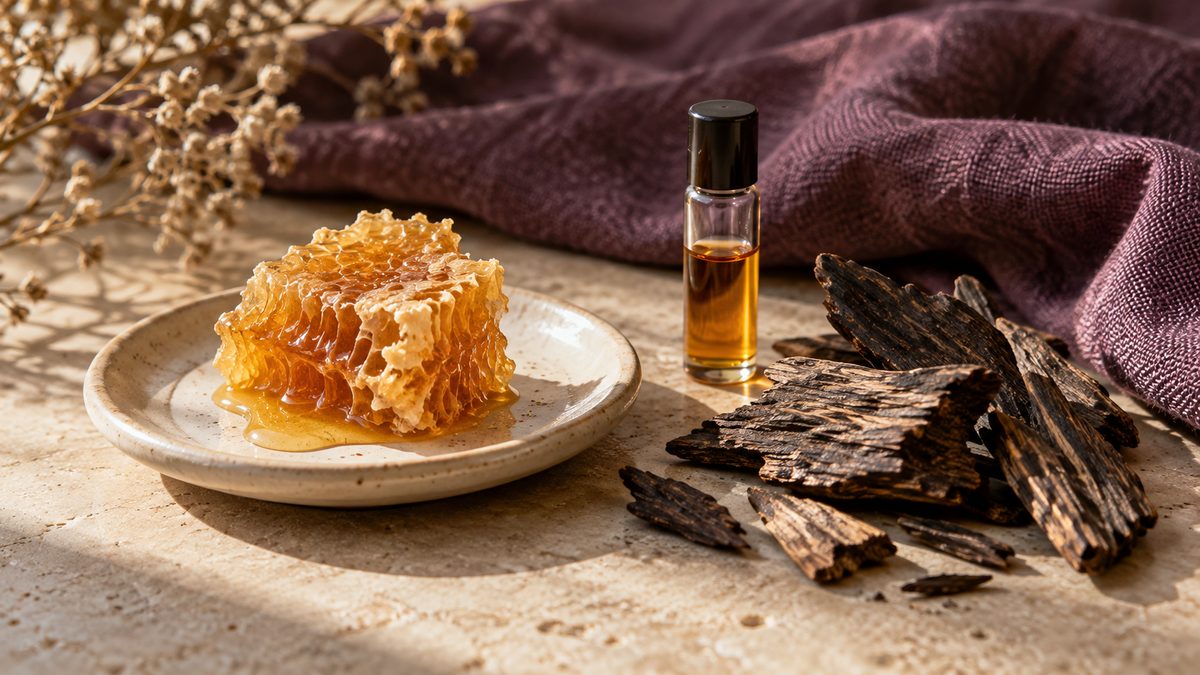
Honey and oud can pair well because honey brings rounded sweetness while oud contributes woody depth, sometimes with smoky or animalic edges. On skin, that contrast may feel like warm wax and dry timber, a floral sweetness over dark woods, or a richer, more challenging blend. The note names alone cannot tell you which version you will get.
If you are searching for a honey oud perfume, start by deciding what you want the honey to do. It might soften the woods, dominate them with sweetness, or add a slightly earthy texture. Those are quite different wearing experiences.
Honey is not a single sugary smell. A honey accord can suggest flowers, beeswax, warm hay or a darker animalic quality. Oud can also vary widely, from relatively smooth woods to leathery, medicinal or barnyard-like impressions. Read the oud note guide for that range before assuming every oud-labelled scent will smell alike.
The pairing works through both contrast and shared texture. Sweetness can round an austere wood impression; waxy or earthy honey facets can also connect with an oud accord's darker side. Neither effect requires the perfume to smell like dessert.
A note list describes the intended scent impression, not a recipe or proof of natural raw materials. A fragrance may use an accord to suggest oud or honey. Ingredient information and the manufacturer's description answer different questions, so avoid treating a prominent note as a guaranteed ingredient.
The most useful question is not simply whether the sample smells sweet. Ask what sits around that sweetness and what remains when the opening settles.
| Impression you notice | What it may mean for your choice | Next check |
|---|---|---|
| Soft, waxy warmth | Honey feels rounded rather than syrupy | Does it stay comfortable in a warm room? |
| Floral sweetness | Petal-like facets lead the pairing | Do the flowers remain pleasant later? |
| Dry wood beneath sweetness | Contrast keeps the scent from feeling edible | Does the drydown become too austere? |
| Smoky or leathery darkness | The woody accord is more forceful | Can you enjoy it at ordinary wearing distance? |
| Earthy or animalic warmth | Both accords may emphasise darker facets | Try a full wear before committing |
These are smelling prompts, not a prediction of how every formula develops. You may notice several together, or find that the surrounding notes are more obvious than either honey or oud.
If you prefer edible sweetness, the gourmand perfume guide can help put that preference into words. If you want dry woods with only a trace of sweetness, say that explicitly when asking for samples.
As one example, Bond No. 9 New York Oud lists red plum, saffron, orange zest, red rose, iris, patchouli, musk, honey and vetiver. That published list gives context for honey alongside fruit, flowers and earthy materials, but it does not establish a universal honey-and-oud formula.
The name itself should not be used to fill gaps in a note list. Nor should this example lead you to expect every perfume in the pairing to contain the same supporting notes. Compare the actual description of the sample in front of you.
There is also no reason to assume that a retailer stocks a particular honey-and-oud perfume because a search result mentions the pairing. Check the current product page or ask the seller about that exact item and sample availability.
Heat can make a scent feel more diffusive, and a sweet, dense composition may become more noticeable than you intended. Test a small application during normal activity rather than deciding in an air-conditioned shop alone. Notice how it feels when you move between outdoor warmth and an indoor room.
Cold conditions can make the same application seem quieter. That does not mean the perfume needs immediate topping up: it may become much more apparent when you enter a heated room or remove a coat.
Use your normal settings as the test. Someone who spends winter in heated offices has a different wearing environment from someone outdoors for much of the day. Our summer and winter perfume comparison explains why the weather label is only a starting point.
The perfume testing guide offers a fuller routine. If the scent irritates your skin, stop using it and seek professional advice if symptoms persist. Do not keep wearing an uncomfortable sample to complete a test.
Record a few plain words after each wear: waxy, floral, dry, smoky, too sweet, comfortable close up. A useful choice is one whose balance you want to smell again, in the places where you will wear it.
A guide to the note’s usual role, not a fixed formula or an ingredient list.
Notes overlap as a fragrance develops. Placement varies with the finished composition.
No. A note describes a smell and does not establish the ingredients. Never use perfume as food or apply kitchen honey as a substitute for a fragrance product.
Any fragranced liquid may mark some fabrics. Follow the product directions, avoid delicate materials and do not assume a clear liquid is stain-free.
It can be, if the sample feels comfortable. Honey does not guarantee a mild oud accord, so compare a softer woody interpretation with a darker one before choosing.
Try each separately first. If you later experiment, use small amounts and keep the products identifiable so you can judge which combination you prefer.
For general information. Patch test a finished perfume as directed before wider wear. Stop use and see a doctor if irritation develops.
Notes A–Z
Oud smells resinous and woody, with possible smoky, leathery, medicinal, sweet or animalic facets.
4 min readHow to wear fragrance
Test perfume by limiting competing scents, assessing an opening on paper, and giving a suitable finished sample a separate skin-wearing day.
4 min readScent through the seasons
Summer fragrance choices often favor bright citrus, airy florals and dry woods, while winter choices may lean toward warm amber, vanilla and richer woody textures.
4 min readFragrance families
What makes a perfume gourmand, how edible accords are built, and how to choose vanilla, nutty or roasted scents without sweetness overload.
4 min read