Notes A–Z
Rose in Perfume: Fresh Petals, Spiced Honey and Different Extracts
Rose can smell green, citrusy, honeyed or spicy. Explore distilled oil, absolute, key rose molecules and how to find your preferred floral style.
4 min readNotes A–Z
Oud smells resinous and woody, with possible smoky, leathery, medicinal, sweet or animalic facets.
By The Bla Blu Bli Fragrance Library editors · Published October 21, 2026 · Updated October 22, 2026 · 4 min read
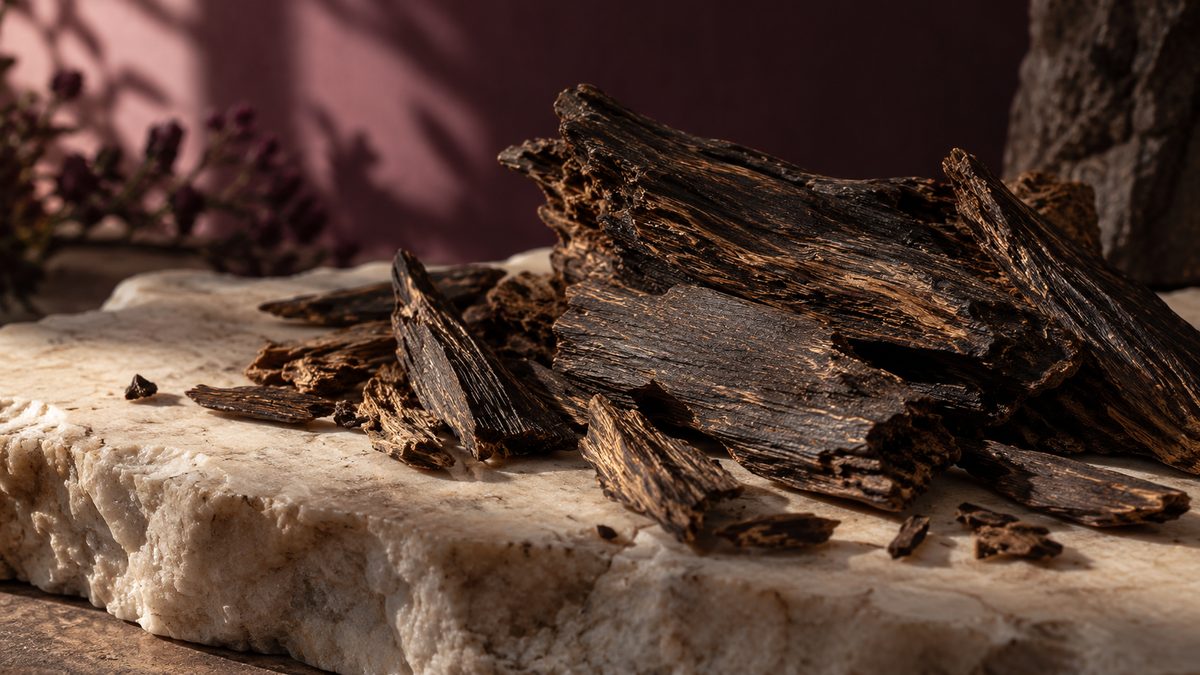
Oud smells resinous and woody, with possible smoky, leathery, medicinal, sweet or animalic facets. Natural oud comes from resin-rich agarwood, while many perfumes use constructed oud accords. A clean dry-wood interpretation and a strongly animalic one can share the same note name without offering similar wearing experiences.
Agarwood forms in certain Aquilaria and Gyrinops trees when biological processes and stress lead to resin deposition in the wood. Not every piece of wood from these trees has the same aromatic character. The resinous material, rather than plain pale timber, is central to the oud association.
Growing and production sources are found across parts of South and Southeast Asia. Selected resin-rich wood can be distilled to produce oud oil, often after preparation suited to the producer's method. Wood grade, preparation and distillation all influence the result.
Agarospirol and other sesquiterpenes are among the compounds discussed in relation to agarwood aroma. The wood and extracts contain a complex range of constituents, not a single oud molecule. Some constituents of resin-rich wood are not represented in the same way in a distilled oil.
Origin stories can be interesting, but a country name cannot reliably predict animalic strength, sweetness or smoke in the finished perfume. Material variation and the formula around it remain decisive.
| Oud facet | What the word may describe | A useful distinction |
|---|---|---|
| Resinous wood | Dense, fragrant, slightly balsamic timber | Richness versus sweetness |
| Smoke | Charred wood or dry aromatic air | Background smoke versus dominant smoke |
| Animalic | Bodily, leathery or barnyard association | Warm depth versus discomfort |
| Medicinal | Sharp, bandage-like or camphoraceous edge | A scent association, not a treatment |
| Sweet wood | Rounded balsamic warmth | Natural facet versus a sweetened base |
Try naming the troublesome facet rather than dismissing all oud as strong. You may dislike animalic depth but enjoy resinous wood, or dislike sweetness while enjoying a rough smoky edge. Those preferences suggest different samples.
Natural oud oil can contain unusual and changing details that are difficult to summarise in a short note list. A synthetic or blended oud accord can reproduce selected aspects, provide consistency or create a cleaner style. It may include other natural woods and resins without using agarwood oil.
A convincing oud impression does not prove natural agarwood content. Equally, a natural ingredient does not guarantee that a finished fragrance will smell animalic or rough. Perfumers can surround it with smooth materials or use it quietly beneath a different theme.
Ask for explicit ingredient-source information if natural oud content matters to you. Do not use darkness of liquid, a long-lasting smell or a high asking price as proof. Those are not reliable chemical or sourcing tests.
Oud usually works in the base, supplying persistent wood and resinous depth. Strong facets may be noticeable immediately, so the base placement is a structural description rather than a delayed start.
Rose offers a recognisable petal centre against the darker wood. Saffron can reinforce dry leathery warmth, while incense builds a more aromatic resin-and-smoke direction. Each pairing can magnify different parts of the oud impression.
Sandalwood smooths the base, cedar introduces a drier timber outline and patchouli adds earth. Vanilla or amber can round the rough edges but also create a dense sweet background. If you want austere oud, inspect the drydown for that sweetness rather than trusting a dark opening.
In a floral or woody composition, oud may serve mainly as a shadow behind other notes. You do not have to identify a literal agarwood smell for the accord to influence the fragrance's texture.
Start with two contrasting finished fragrances: a cleaner woody oud and a more resinous or animalic interpretation. Do not begin by applying concentrated oud oil directly to skin. A raw material and a formulated fragrance involve different uses and exposure.
On separate paper strips, allow the initial alcohol to disperse, then record wood, sweetness, smoke and animalic facets independently. Revisit later and ask which aspect persists. A dramatic opening can settle considerably, while a quiet opening may reveal a dense base.
Wear a promising sample on another day according to the directions. Begin conservatively and notice how it behaves indoors as well as outdoors. The sillage guide explains why a perfume you have grown used to may still be noticeable to people nearby.
If you find the fragrance tiring, stop the trial and use the specific problem to choose differently. More experience is not a requirement to enjoy a smell that currently feels unpleasant. You may simply prefer a cleaner wood or a less sweet resin base.
Agarwood sourcing raises conservation and trade questions. Species, cultivation and supply chain matter, and some trade is controlled. Current rules and documentation should be checked with official trade or customs sources when relevant; a perfume note description is not evidence of legal or responsible sourcing.
For wearing, a smoky oud may feel more comfortable in cool air, while a transparent woody version can suit daytime. The complete formula determines weight and reach, so seasonal assumptions need testing.
Natural oud and reconstructed accords can both be unsuitable for an individual with fragrance sensitivity. Follow the finished label, check known triggers and discontinue use if irritation appears. Seek professional advice for ongoing reactions rather than applying repeated tests to affected skin.
A guide to the note’s usual role, not a fixed formula or an ingredient list.
Notes overlap as a fragrance develops. Placement varies with the finished composition.
Agarwood usually refers to the resin-rich wood, while oud can refer to its oil or a perfumery impression. Usage varies, so ask which material a source claim describes.
No. Colour does not establish aromatic character, authenticity or sourcing. Evaluate the smell and seek credible product information rather than treating darkness as a grading system.
A clean woody accord, citrus contrast or carefully chosen material can make an oud fragrance feel relatively open. Freshness does not establish whether the oud effect is natural or constructed.
Animalic associations can be part of an intended oud style. A changed or suspect product needs separate assessment; the descriptor alone cannot prove contamination or identify a production problem.
For general information. Patch test a finished perfume as directed before wider wear. Stop use and see a doctor if irritation develops.
Notes A–Z
Rose can smell green, citrusy, honeyed or spicy. Explore distilled oil, absolute, key rose molecules and how to find your preferred floral style.
4 min readNotes A–Z
Saffron in perfume often smells dry, hay-like and leathery, with warm spice, faint sweetness and sometimes metallic or rubbery facets.
4 min readIngredients
Natural extracts and synthetic aroma materials are both useful tools in perfume.
4 min readNotes A–Z
What aldehydes mean in perfume, why some smell sparkling or soapy, and how these varied materials transform floral and clean fragrance accords.
4 min read