How to wear fragrance
Perfume Sampler Sets: A Testing Plan That Helps You Choose
Use perfume sampler sets over separate wear days, record useful comparisons and store small vials so you can revisit favourites.
5 min readHow to wear fragrance
Compare perfume advent calendars by sample size, usable contents, concentration, storage and full-bottle availability before choosing one.
By The Bla Blu Bli Fragrance Library editors · Published November 7, 2026 · Updated November 7, 2026 · 5 min read
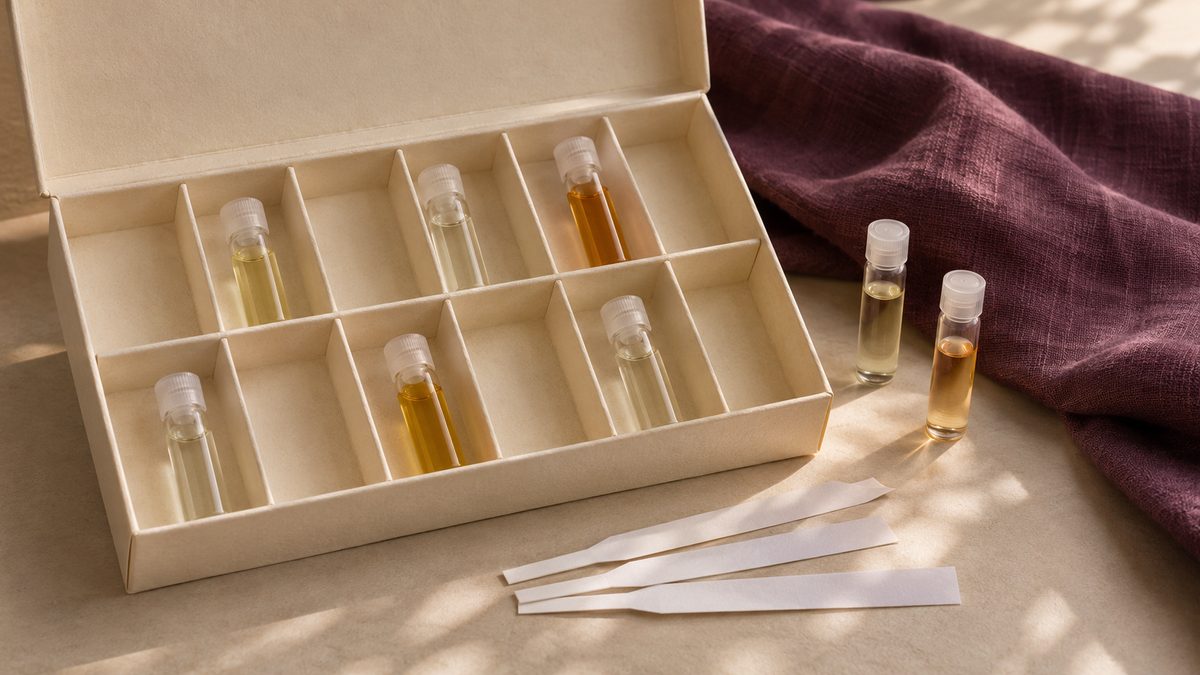
A perfume advent calendar is worth considering when its disclosed contents give you enough of the fragrances you want to try, in usable sizes and formats. Judge the individual samples, their condition and the route to buying a favourite, rather than the number of doors or the size of the box.
The same checks apply when a listing calls it a cologne advent calendar for 2026. The year identifies the edition; it does not establish freshness, quality or suitability for your taste. A beautiful box can still leave you with too little liquid to test properly or several extras you would never choose.
Find the full contents list before buying. Count fragrances separately from body products, candles, accessories and other additions. Those extras may be enjoyable, but they do not provide the same opportunity as a wearable perfume sample.
Check for repeated fragrances in different formats. A spray and a matching scented cream might make a pleasant pair, yet they are not two different perfumes to explore. If the purpose is discovery, variety matters more than a high item count.
Think about your existing collection too. A calendar containing samples you already own offers less new information. For a present, compare the contents with the recipient’s known preferences using our perfume gift guidance. A large assortment is not automatically more thoughtful than a small, relevant selection.
Volume alone does not tell the whole story. A spray lets you reproduce a familiar application more easily than a dab vial, while a miniature bottle may be attractive but awkward to dose. Do not assume a small decorative bottle includes an atomiser.
You need enough liquid for an initial impression and another wear if the scent interests you. There is no reliable universal number of wears per millilitre: spray output, applicator and application habits differ. Avoid judging a calendar by an estimated spray count unless the seller explains how it was measured.
| Detail to inspect | Why it affects the experience | What to clarify if missing |
|---|---|---|
| Volume for each item | Small and larger samples serve different testing needs | Individual sizes, not just total liquid |
| Spray, dab or roller applicator | Changes dosing and the way the opening is experienced | Whether an atomiser is included |
| Exact fragrance version | Similar names can refer to different compositions | Concentration and version for every sample |
| Perfume versus other products | Extras may not serve a sampling goal | Which doors contain wearable fragrance |
| Identifying information | You need to recognise a favourite later | Labels or a matching contents card |
A total volume can be useful, but only after this breakdown. Adding together a body product and a perfume sample does not produce a meaningful measure of fragrance discovery.
Eau de toilette, eau de parfum and parfum labels help identify what is inside. They do not rank every scent on a common scale of quality, projection or longevity. A lighter-labelled fragrance can still feel assertive, and a more concentrated one can sit close to skin.
Versions may also smell different. If the calendar contains one concentration and a shop stocks another, do not assume the full bottle will reproduce your sample. Our concentrations explanation covers why matching the precise version matters.
Treat a mixed-concentration calendar as a chance to compare experiences. Record which version you tested, the application method and how it felt after the opening settled. Otherwise, a favourable memory can lead you to buy a different fragrance by mistake.
A sample is more useful when it can lead to something you can buy and wear. Look for the exact full-size version in the seller’s current catalogue, particularly if the calendar includes limited editions, discontinued items or an earlier seasonal assortment.
If an item is unavailable, that need not rule out the calendar. It may still be interesting as a scent experience. It does change the decision for someone looking for a new daily perfume, because finding a favourite could lead to frustration rather than a practical purchase.
Read any redemption terms separately. Check the eligible bottles, expiry conditions, regional restrictions and whether unused credit is retained. Never infer that buying the calendar includes a later bottle. Our gift sets article can help distinguish a sampling offer from a bundle of products.
Ask whether the contents are unused, properly closed and supplied with identifying product information. An edition date is not a bottling date. Older stock is not necessarily spoiled, and a newly released box is not proof that every vial was recently filled.
Avoid listings that leave the origin or condition unclear. On arrival, inspect for leakage, damaged closures and missing contents before opening everything. Keep the packaging and follow the seller’s process if something appears wrong.
Colour alone cannot establish freshness because formulas vary and can change appearance over time. A noticeably altered smell compared with a known sound sample is more useful evidence, but it still deserves a query to the seller rather than a guessed diagnosis. See perfume storage advice for keeping the remaining samples away from heat and strong light.
Ignore the temptation to count every item as equally desirable. Divide the list into fragrances you want to test, uncertain choices you would explore, and products you are unlikely to use. Packaging and surprise can have value to you, but name that value separately from the liquid.
A calendar suits someone who enjoys an extended ritual and accepts a few misses. A focused sampler may suit someone choosing one fragrance for work or trying to understand a particular family. Our sampler set guide explains how to turn a smaller selection into useful wear tests.
Finally, opening a door does not require wearing its contents immediately. Keep the daily surprise if you enjoy it, then test at your own pace. Giving each promising fragrance a separate day makes the purchase more informative than rushing through several scents because the calendar says it is time.
Yes, if you agree how to divide the contents. Keep each sample with its identifying information and avoid sharing applicators that touch skin.
That would remove the surprise and may affect return eligibility. Use the published contents list, and check the seller’s terms before opening anything.
No. Cologne can be used as a general shopping term, particularly for masculine fragrance. Check each listed fragrance and concentration rather than relying on the calendar title.
A set with a fully disclosed contents list may suit them better. If they only want one familiar fragrance, a calendar may offer little useful choice.
Check the current liquid and baggage rules with the relevant airport, authority and airline. Small containers still need to meet the rules for the whole bag.
For general information. Patch test a finished perfume as directed before wider wear. Stop use and see a doctor if irritation develops.
How to wear fragrance
Use perfume sampler sets over separate wear days, record useful comparisons and store small vials so you can revisit favourites.
5 min readConcentrations
Parfum, eau de parfum, eau de toilette and eau de cologne are concentration and style labels, while perfume oil describes a carrier format.
4 min readHow to wear fragrance
Check perfume gift sets and discovery sets for exact contents, sizes, concentrations, redemption terms and storage before deciding what is useful.
5 min readHow to wear fragrance
Store perfume tightly closed in a cool, stable place away from direct light and heat.
4 min read