Notes A–Z
Cardamom in Perfume: What It Smells Like and How It Is Used
Cardamom smells fresh, aromatic and gently warm. Where the oil comes from, how perfumers use it, what it pairs with, and when to wear it.
3 min readNotes A–Z
Pink pepper smells fresh, rosy and gently peppery. Learn its Schinus sources, extraction, opening role and contrasts with other spice notes.
By The Bla Blu Bli Fragrance Library editors · Published October 21, 2026 · Updated October 22, 2026 · 5 min read
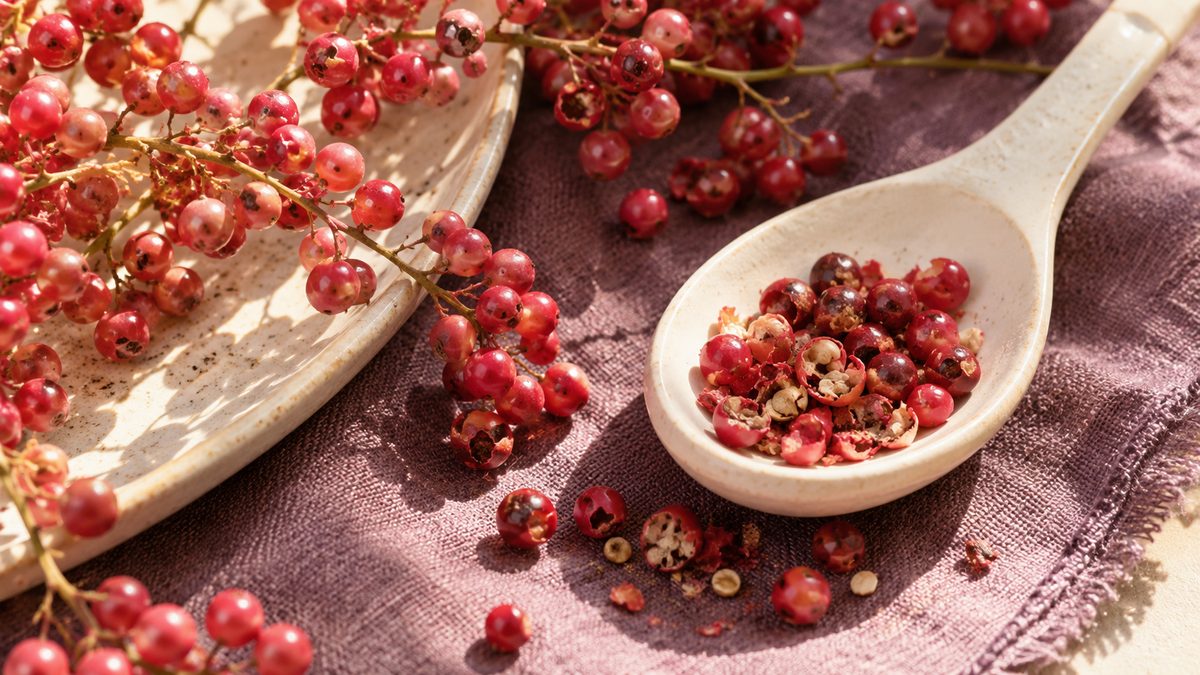
Pink pepper in perfume smells bright, gently peppery and often rosy, with citrus-like and lightly resinous facets. It usually gives lift rather than the heavy warmth associated with baking spices. If you want a lively opening without a strongly juicy citrus effect, it is a useful note to explore.
Perfumery pink pepper is associated with fruits of Schinus species, including Schinus molle and Schinus terebinthifolia. These trees have South American origins and are cultivated or found in other regions as well. Their pink fruits are botanically distinct from black pepper, which comes from Piper nigrum.
The distinction matters because the smells are not interchangeable. Pink pepper can feel more floral and airy, while black pepper often gives a drier, more directly peppery impression. Individual oils and accords vary, so this is a comparison rather than a rigid boundary.
Distillation of the fruits can produce an essential oil. Other extraction methods may yield materials with a different balance of volatile and heavier facets. If a supplier describes an extract, the method is worth checking rather than assuming every pink pepper material is the same oil.
Monoterpenes such as alpha-pinene, limonene and delta-3-carene may contribute to the aroma, with composition depending on species and material. Their bright resinous or citrus-like qualities help explain the note's lift. The pleasant rosy impression is the result of the full aromatic balance.
The word pepper can lead you to expect a hot, biting smell. Pink pepper often behaves more like a flicker of aromatic brightness. It can be sharp, but it is not defined by the sensation of eating a peppercorn.
| Pink pepper facet | Sensory comparison | What it contributes |
|---|---|---|
| Rosy | Fresh petals with a spicy edge | A link into floral hearts |
| Citrus-like | Zest without much juice | Brightness above woods or musks |
| Resinous | Fresh aromatic sap | A bridge towards dry bases |
| Peppery | A quick, light prickle | Definition in the opening |
A faintly fruity quality can also appear, but it need not make the perfume sweet. A dry woody base can keep the whole effect crisp. Vanilla or rounded musks may make the same opening feel softer.
Do not expect every perfume listing pink pepper to smell recognisably of the berry. It is often used as a small accent, sharpening other notes rather than becoming the subject. Its contribution may be easier to recognise by comparing a lively opening with a flatter one.
Pink pepper is commonly used in the top and upper heart. Its more volatile facets help define the first impression, while supporting materials can extend a rosy-spicy idea into the flowers. There is no fixed time at which the note must disappear.
With bergamot, it can produce a bright, dry opening without relying only on citrus peel. With rose, its rosy aspect becomes easier to identify and can make petals feel fresher or more textured.
Cardamom offers a useful contrast. Cardamom often has a cooler cineole-like side and more rounded warmth, while pink pepper may feel more sparkling and rosy. Used together, they can provide different kinds of aromatic freshness.
Saffron is usually drier and more leathery or hay-like. A perfume containing both can begin brightly and move towards a darker texture. That change can be attractive, but the cheerful opening may not represent the base you will wear for hours.
A pink pepper accord may use natural oil, selected aroma materials or both. A perfumer can emphasise its floral brightness, reduce a rough resinous edge or support it with other spices. The note name does not tell you how that balance was achieved.
Natural variation is part of the source material's character, but it does not guarantee that every extract will feel more delicate. A reconstruction may be smoother or more abstract. Judge the effect first, then investigate provenance if it matters to your decision.
Nor does a natural spice story establish skin suitability. Pink pepper's botanical family and any personal allergy history deserve more careful attention than a broad claim that essential oils are gentle. Product-specific questions belong with the manufacturer and, for diagnosed allergy concerns, a healthcare professional.
A perfume note list is not an ingredient inventory. It cannot establish that a particular fruit extract is absent or present at a level relevant to you. Use the finished product's label and obtain clarification when needed.
For daytime or warm-weather wear, pink pepper with citrus, pale woods or restrained musks can feel lively. For cooler conditions, a version with rose, resins or vanilla may give more warmth. These pairings narrow your samples; they do not predict projection.
The key question is whether you like what follows. A crisp opening can settle into a sweet amber, a dry wood or a soft floral musk. If the first minutes are your favourite part, make sure the rest still feels comfortable before buying.
In close shared spaces, begin with a modest application according to directions. Bright spicy notes can be noticeable in the air, and their disappearance from your attention does not mean the entire perfume has faded. Avoid topping up just to recreate the opening.
Select one pink pepper-floral perfume and one pink pepper-wood perfume. On separate strips, note the balance of rosy, citrus-like and resinous effects after the spray settles. Keep the samples apart so their openings do not blend.
Return when the bases are clearer. Write down whether either perfume has become sweeter or darker than you wanted. Then wear the preferred sample on its own on another day, using a normal application rather than trying to maximise intensity.
A culinary reference can help you understand the aroma, but do not rub crushed fruits or undiluted oil on skin. Ready-to-wear fragrance is the appropriate basis for a skin trial. Stop use if a product causes irritation and seek professional advice for persistent reactions. A peppery smell should be an aromatic detail you enjoy, not discomfort you tolerate.
A guide to the note’s usual role, not a fixed formula or an ingredient list.
Notes overlap as a fragrance develops. Placement varies with the finished composition.
A spicy smell should not be confused with an intended skin sensation. If a perfume stings or irritates, stop using it.
Not necessarily. The natural material has rosy and peppery facets, although an accord may also use other ingredients.
No. Food associations and botanical names do not make a fragrance suitable for consumption.
No. Seek advice from a qualified professional and product information from the manufacturer when a specific allergy is relevant.
For general information. Patch test a finished perfume as directed before wider wear. Stop use and see a doctor if irritation develops.
Notes A–Z
Cardamom smells fresh, aromatic and gently warm. Where the oil comes from, how perfumers use it, what it pairs with, and when to wear it.
3 min readNotes A–Z
Bergamot smells like bright citrus peel with a bitter, green edge and a soft floral undertone.
4 min readNotes A–Z
Rose can smell green, citrusy, honeyed or spicy. Explore distilled oil, absolute, key rose molecules and how to find your preferred floral style.
4 min readNotes A–Z
Saffron in perfume often smells dry, hay-like and leathery, with warm spice, faint sweetness and sometimes metallic or rubbery facets.
4 min read