Notes A–Z
Incense and Frankincense in Perfume: Resin Before Smoke
Incense in perfume can smell resinous, aromatic and smoky, while frankincense itself often adds bright citrus-like, peppery and pine-like facets.
4 min readNotes A–Z
Explore frankincense in perfume, from citrus and pine to resinous warmth, with pairing ideas, sourcing questions and festive wearing advice.
By The Bla Blu Bli Fragrance Library editors · Published October 24, 2026 · Updated October 24, 2026 · 4 min read
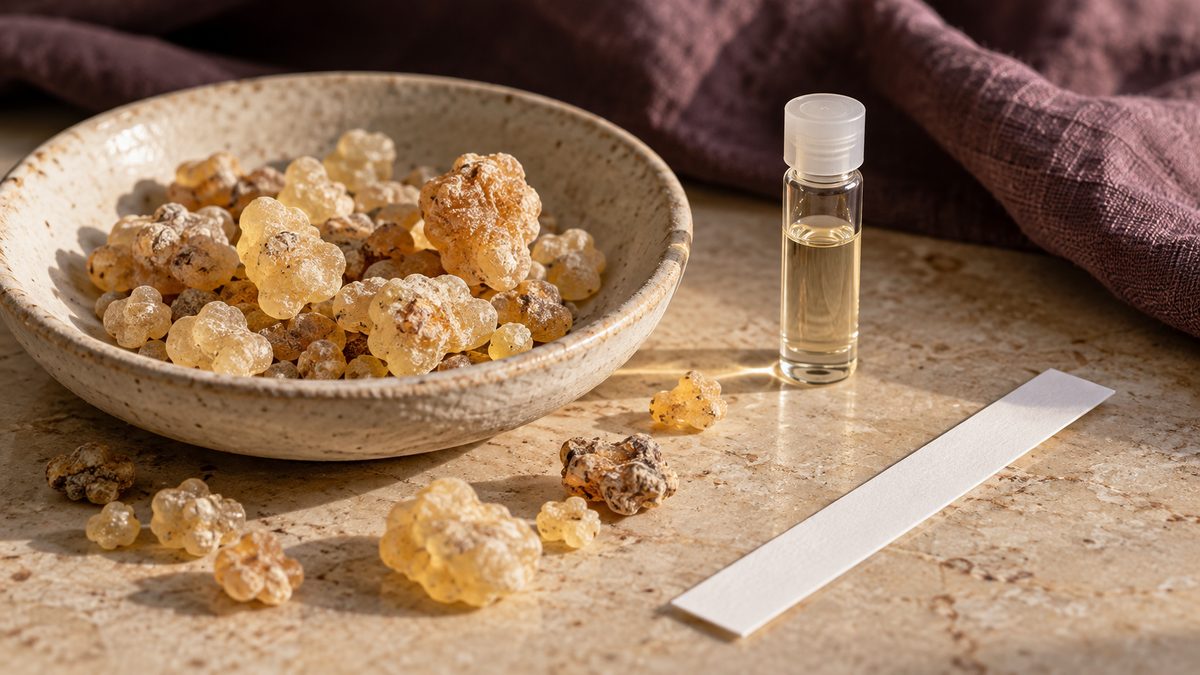
Frankincense in perfume smells resinous, often with a lemony brightness, pine-like freshness and a dry, balsamic finish. Also called olibanum, it need not smell like dense smoke: a perfume can show the clear, aromatic side of the resin without suggesting anything burning.
That distinction matters if you want a festive scent but dislike smoky rooms. Look beyond the word incense and ask how much citrus, wood, sweetness and smoke remain once the perfume settles.
Frankincense is the hardened aromatic resin of Boswellia trees. The resin is collected after cuts in the bark allow it to exude and dry into pieces often called tears. Different species and growing regions provide materials with differing aromatic profiles.
Boswellia trees grow in parts of Africa, the Arabian Peninsula and South Asia. A broad geographical description cannot tell you exactly how a finished fragrance will smell. Species, resin grade, handling and processing all influence the material before the perfumer begins composing with it.
Steam distillation produces an essential oil that often highlights bright, volatile facets. Other extraction methods can give materials with a different balance of resinous depth and freshness. A perfume's note list rarely identifies every preparation used, so treat it as a description of the effect rather than a complete recipe.
Smelling frankincense resin at room temperature differs from smelling it on hot charcoal. Heating changes what reaches your nose and introduces the experience of burning. The memory of that ritual can make people expect every frankincense perfume to be smoky.
In a composed fragrance, smoke may come from supporting materials or a separate accord. Equally, a perfumer may build an olibanum impression using a mixture of natural and manufactured materials. Our incense article explains the broader family of incense effects.
| Facet | What it may suggest | What to notice on a strip |
|---|---|---|
| Citrusy | Lemon peel or a bright aromatic opening | Whether it stays crisp or turns sharp |
| Coniferous | Pine needles and cool woodland air | Whether the greenness feels fresh or medicinal |
| Resinous | Dry balsam and warmed tree resin | How much sweetness appears later |
| Smoky | Smouldering wood or incense ash | Whether smoke supports or hides the resin |
These are useful sensory comparisons, not promises that each named object is an ingredient. A fragrance can show several facets together, with their balance changing through wear.
Citrus brings out frankincense's sparkling edge. Bergamot can make an opening feel airy, especially when the base stays dry. If you like the first spray but dislike the later richness, pay attention to the amber or vanilla beneath that brightness.
Conifer notes extend the forest association. Read about pine and fir if you want to distinguish sharp needles from softer balsamic warmth. Cedar can supply a dry frame, while sandalwood gives a smoother, creamier contrast.
Rose beside frankincense can suggest petals against dry resin. Amber adds rounded warmth; vanilla can soften the edges into something sweeter. None of these combinations automatically becomes heavy, because the amounts and supporting materials decide the finished balance.
For a quieter style, ask for transparent woods with a resin accent. For a darker evening scent, compare a resin-led sample with one containing an obvious smoky accord. Keeping those two ideas separate helps you describe what you enjoy.
Repeated or poorly managed harvesting can put pressure on resin-producing trees. Responsible sourcing involves more than a romantic description of a remote origin. Tree health, harvesting practices and the route from collector to supplier are relevant questions.
Useful information might identify the Boswellia species, the sourcing region and a documented supplier programme. An unexplained claim such as sustainable resin gives you little to assess. If a seller supplies no detail, record that uncertainty rather than filling it with assumptions about a country or community.
Natural does not automatically mean environmentally preferable, and a synthetic reconstruction does not by itself establish a lower impact. Our naturals and synthetics comparison covers why the finished ingredient choice needs context. You can still choose by smell while recognising the limits of the information available.
Frankincense can suit winter evenings because its resinous warmth works beside spices, woods and soft fabrics. It can also suit a bright daytime fragrance when citrus and aromatic facets lead. The season is an association, not a requirement to choose a dense formula.
Before a dinner or gathering, try the sample in a heated room during an ordinary evening. Notice whether it remains comfortable at conversational distance and whether a smoky base interferes with enjoying food. A scent that feels restrained outdoors can be more noticeable in close indoor company.
Apply modestly according to the product directions and let the opening settle before deciding on more. Do not combine a new resin perfume with several scented body products during the first trial, because the mixture makes its behaviour harder to judge.
Start by smelling the finished perfume on a strip, then return after the bright opening has softened. Write separate notes for freshness, sweetness and smoke rather than a single judgement of strong or weak.
Wear your preferred sample on another occasion without layering. Check the late base as carefully as the beginning: a resin you like may sit above a sweet amber you find tiring. Our testing perfume guide helps organise that comparison.
Use finished fragrances rather than raw extracts on skin. Fragrance ingredients can cause irritation or allergy, including those of natural origin. If a product causes a reaction, stop using it; persistent symptoms need advice from a healthcare professional. Enjoying the smell of resin is a preference, not a reason to make therapeutic claims for wearing it.
A guide to the note’s usual role, not a fixed formula or an ingredient list.
Notes overlap as a fragrance develops. Placement varies with the finished composition.
It can recall incense used in worship, but that association depends on personal experience. Bright citrus and woody versions may suggest an aromatic resin instead.
Olibanum is another name for frankincense. Descriptions may use either term without signalling a separate ingredient.
Raw resin and materials intended for burning are not finished skin fragrances. Choose a product formulated and labelled for personal fragrance use.
No. Colour reflects many possible ingredients and changes during storage. It cannot reveal the amount or quality of frankincense in the formula.
For general information. Patch test a finished perfume as directed before wider wear. Stop use and see a doctor if irritation develops.
Notes A–Z
Incense in perfume can smell resinous, aromatic and smoky, while frankincense itself often adds bright citrus-like, peppery and pine-like facets.
4 min readNotes A–Z
Amber in perfume usually smells warm, resinous and softly sweet, with vanilla, balsamic and sometimes leathery facets.
4 min readIngredients
Natural extracts and synthetic aroma materials are both useful tools in perfume.
4 min readNotes A–Z
Understand clove and eugenol in perfume, useful pairings, the difference between spicy and sweet, and how to approach ingredient labelling.
5 min read