Notes A–Z
Incense and Frankincense in Perfume: Resin Before Smoke
Incense in perfume can smell resinous, aromatic and smoky, while frankincense itself often adds bright citrus-like, peppery and pine-like facets.
4 min readNotes A–Z
What myrrh smells like in perfume, from bitter resin to balsamic warmth, with incense history, useful pairings and a practical sampling method.
By The Bla Blu Bli Fragrance Library editors · Published October 23, 2026 · Updated October 23, 2026 · 5 min read
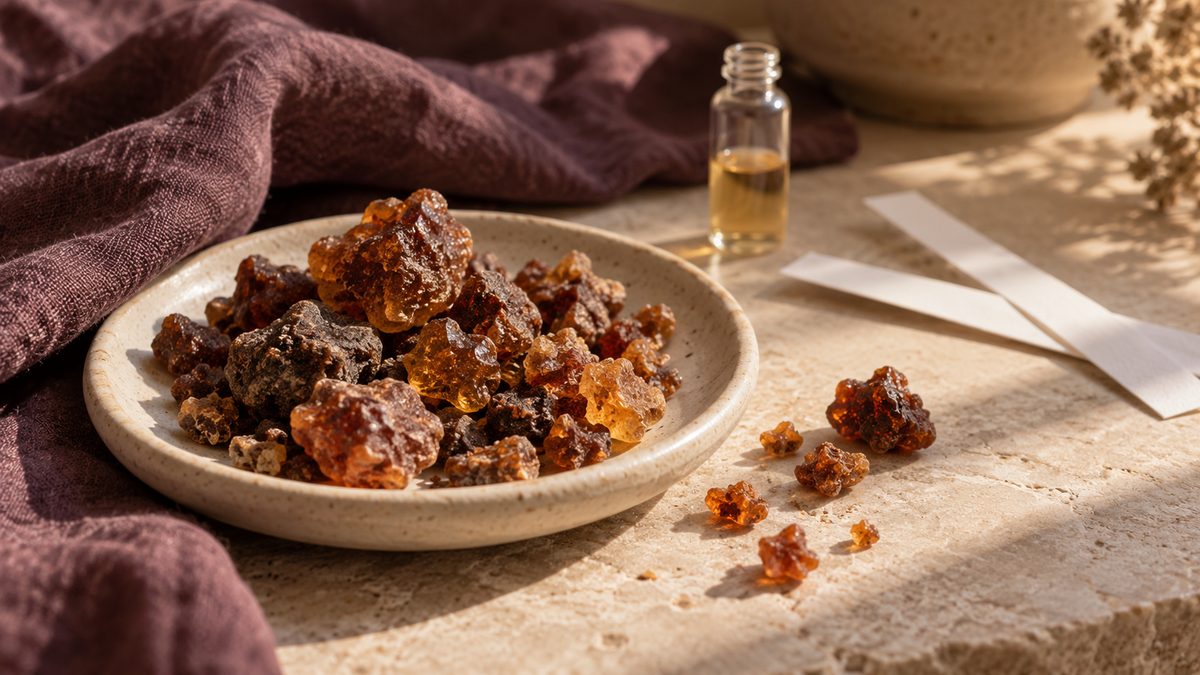
Myrrh in perfume smells resinous, bitter and balsamic, often with woody, earthy or medicinal edges beneath a rounded warmth. It can make a fragrance feel dark and contemplative without making it sugary. Although myrrh has a long history in incense, a perfume containing the note need not smell of smoke.
The useful distinction is between warmth and sweetness. Myrrh can supply the first while holding back the second, which makes it worth exploring if you enjoy rich perfume but find dessert-like bases tiring.
Myrrh is an aromatic gum-resin obtained from trees in the genus Commiphora. It collects in irregular pieces that can range from amber-brown to darker reddish shades. The familiar dry lumps are raw material, rather than small pieces of finished perfume.
Perfumery can use distilled or extracted myrrh materials, alongside other ingredients that develop a myrrh impression. Different preparations do not smell identical. An oil, an extract and a constructed accord can bring different proportions of sharpness, warmth and depth.
This matters when reading a note pyramid. The word myrrh tells you the intended aromatic direction; it does not disclose a complete recipe or guarantee a particular natural extract. Our explanation of naturals and synthetics helps separate material origin from the finished effect.
In perfumery, balsamic describes a rounded, resinous warmth that may carry soft sweetness. It does not mean the smell of vinegar. With myrrh, that warmth often arrives with a dry or bitter counterweight, so the overall effect can be less cuddly than the word balsamic suggests.
| Facet | What it may recall | What to check in a sample |
|---|---|---|
| Bitter resin | Broken aromatic resin, dark bark | Whether the sharp edge stays pleasant |
| Balsamic warmth | Dense, rounded aromatic material | Whether supporting sweetness takes over |
| Medicinal | An old-fashioned aromatic preparation | Whether this feels clean, intriguing or unwelcome |
| Woody and earthy | Dry wood, dusty roots | Whether the base feels too austere |
| Softly sweet | Resin warmed by vanilla-like notes | Whether it remains resinous as it settles |
These are comparisons, not a list of ingredients you should expect to find in every bottle. One wearer may describe a myrrh perfume as polished wood while another notices its medicinal side first. Describe the part you dislike or enjoy before deciding that the whole note is unsuitable.
Myrrh has been used in incense and aromatic preparations since antiquity, including in religious and ceremonial settings. That history helps explain why resinous perfumes can carry associations with ritual, quiet rooms and burning incense.
Smelling raw resin, heating it and wearing a finished fragrance are different experiences. Burning introduces combustion smells that a perfume may omit entirely. A perfumer can suggest incense through dry resin and woods, or can add a separate smoky effect.
Myrrh and frankincense are also distinct materials, even though both belong to the wider incense vocabulary. Do not assume a perfume described as incense-led will give you the bitter, balsamic character you want from myrrh. The incense note guide explores that broader family of impressions.
Historical use is useful context for the aroma, not evidence that a perfume has therapeutic properties. Choose it for how it smells and feels to wear.
With vanilla, myrrh can become rounder and less severe. The contrast can suggest a dark pod or resinous cream rather than cake, although a strongly sweet formula may still feel edible. Smell beyond the opening before calling it a dry vanilla.
Amber accords can extend its warmth and connect it to soft balsams. This is a promising direction if you like the resin but want a more enveloping base. It is less useful if your main aim is to avoid all sweetness, since amber styles vary widely.
Sandalwood can provide a creamy woody setting, while cedar-like woods can underline dryness. Rose gives the bitterness a floral contrast. Spices add further texture, but a heavily spiced formula can obscure the particular resin character you were hoping to study.
For a first comparison, choose samples with different surroundings: a myrrh-and-vanilla style beside a dry incense-and-wood style. Similar descriptions across several bottles teach you less than a clear contrast between two approaches.
Myrrh commonly belongs to the base-note vocabulary. That does not mean it waits invisibly until the end; a resinous theme can be noticeable immediately. It may simply become easier to distinguish once bright opening notes have softened.
Try the fragrance on a strip first and write down separate observations for bitterness, sweetness, smoke and wood. Return later rather than judging from the first alcoholic burst. If you cannot distinguish the myrrh, that does not prove it is absent: it may be blended into the base.
Then wear your preferred sample on its own during a normal day. Notice the transition between cool outdoor air and a heated room, and whether the lingering resin remains comfortable near your face. Use the perfume testing method to keep comparisons consistent.
Avoid layering during this trial. Extra vanilla might hide a medicinal edge, but it also prevents you from learning whether you enjoy the original perfume without adjustment.
Cool weather can make dense resinous fragrances appealing, particularly with wool, dry woods and subdued floral notes in mind. Yet season is only a starting point. A restrained myrrh fragrance may suit daytime, while a very sweet or smoky interpretation may feel intrusive in a warm shared room.
Begin with modest application according to the product directions. Give the base time to develop before adding more, and remember that growing accustomed to the smell does not establish that others can no longer notice it.
Use a finished perfume rather than applying raw resin or concentrated aromatic materials to skin. If a new fragrance causes irritation, stop using it; persistent symptoms warrant professional advice. The best myrrh for you is the one whose settled bitterness and warmth you want to keep smelling, without needing to overpower either facet.
A guide to the note’s usual role, not a fixed formula or an ingredient list.
Notes overlap as a fragrance develops. Placement varies with the finished composition.
It can recall incense, but the setting is an association rather than a fixed smell. Floral, vanilla or woody companions can make the same resin theme feel quite different.
No. A note list describes a smell impression and may refer to natural materials, an accord or both. Consult the maker's material information if origin matters to you.
Raw resin is not a ready-to-wear fragrance ingredient. Solubility, stability and safe use need formulation knowledge; choose a finished cosmetic fragrance instead.
That is a matter of preference and household comfort. Its historical use does not establish a sleep benefit, and a lingering resinous scent may be distracting to some people.
For general information. Patch test a finished perfume as directed before wider wear. Stop use and see a doctor if irritation develops.
Notes A–Z
Incense in perfume can smell resinous, aromatic and smoky, while frankincense itself often adds bright citrus-like, peppery and pine-like facets.
4 min readNotes A–Z
Amber in perfume usually smells warm, resinous and softly sweet, with vanilla, balsamic and sometimes leathery facets.
4 min readNotes A–Z
Vanilla smells warm, softly sweet and balsamic, with possible creamy, woody, smoky or dried-fruit facets. It can suggest a cured pod rather than frosting.
4 min readNotes A–Z
Sandalwood ranges from milky softness to dry warm timber. Learn about Santalum oils, santalols, manufactured alternatives and practical comparisons.
4 min read